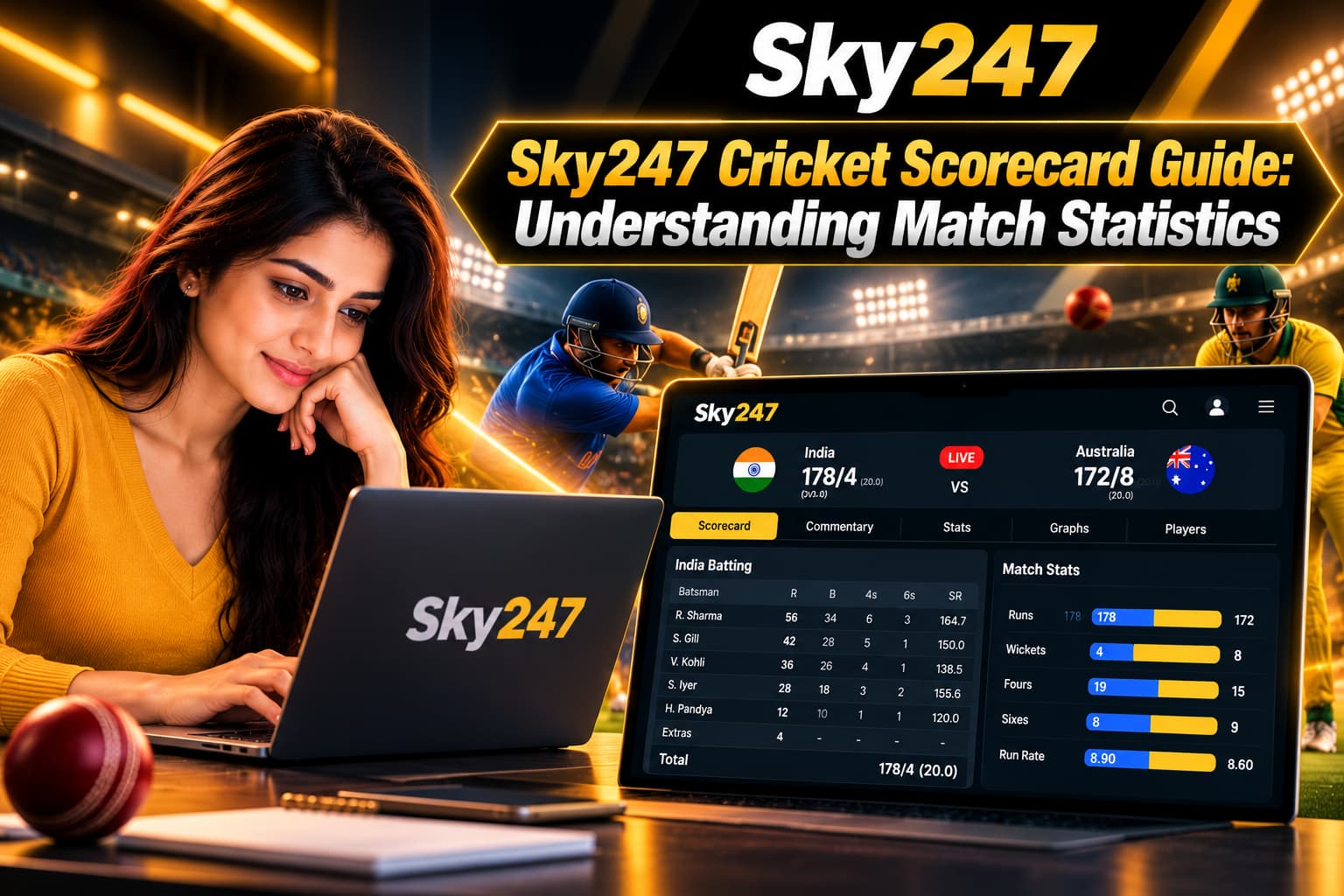
When we follow a cricket match on Sky247, the scorecard helps us understand what is happening on the field. It shows more than the total runs and wickets. We can also see how individual batters are performing, which bowlers are taking wickets, how quickly runs are being scored, and how the match is changing over time.
For someone new to cricket statistics, a scorecard may look confusing at first. We might see numbers such as 156/4, 18.3 overs, a strike rate of 142.85, or an economy rate of 7.50 without fully understanding what they mean.
These numbers tell us different parts of the match story. Some describe individual performances, while others show the overall position of a team.
A cricket scorecard becomes more useful when we know how to read each section. Instead of looking only at the total score, we can understand the batting order, bowling performance, extras, partnerships, and recent scoring patterns.
Our goal is to help us read cricket information more clearly without getting confused by the numbers.
What Is a Cricket Scorecard?
A cricket scorecard is a record of what happens during a cricket match. It shows the runs scored, wickets lost, overs bowled, and performances of individual players.
A basic scorecard usually begins with the team totals. Below that, we may find the batting and bowling figures, extras, fall of wickets, and other match details.
For example, if a team has scored 175 runs while losing six wickets, the score is written as 175/6.
This means the batting team has made 175 runs, and six batters have been dismissed.
A scorecard can also show how many overs have been completed. This helps us understand how quickly the team has scored its runs.
Why Cricket Scorecards Are Important
A scoreboard tells us the current score, but a detailed scorecard explains how that score was reached.
Two teams may have the same total but very different match situations.
For example, one team may have scored 120/2 after 15 overs, while another has reached 120/8 at the same stage.
Although both teams have scored 120 runs, the first team has more wickets remaining.
That difference matters because wickets are an important resource in cricket.
By reading the full scorecard, we can understand the match situation more accurately.
Understanding the Main Cricket Score
The main score is usually the first number we notice when opening a cricket match page.
It combines the total runs and the number of wickets lost.
A score written as 168/5 means the batting team has scored 168 runs and lost five wickets.
The score may also include the number of overs completed.
For example, 168/5 in 18.2 overs gives us more information than the total alone.
What Do Runs and Wickets Mean?
Runs are the points scored by the batting team.
They can come from running between the wickets, hitting boundaries, or receiving extras.
Wickets represent the number of batters dismissed.
A team normally has ten wickets available in an innings because eleven players form the batting side.
When ten wickets fall, the innings usually ends unless the match conditions allow another outcome.
How to Read Overs Correctly
An over normally contains six legal deliveries.
This means 18.2 overs represents 18 completed overs and two legal balls of the next over.
It does not mean 18.2 overs in ordinary decimal form.
This difference is important when calculating scoring rates.
For example, 18.2 overs represents 110 legal deliveries, not 109.2 deliveries.
Understanding this notation helps us read live cricket scores without making calculation mistakes.
Understanding Batting Statistics in a Scorecard
The batting section shows how each batter has performed during the innings.
Common columns include runs, balls faced, fours, sixes, and strike rate.
Some scorecards also show how the batter was dismissed.
These details help us understand whether a player scored quickly, played a longer innings, or contributed through boundaries.
What Does the Runs Column Show?
The runs column shows how many runs a batter has scored.
These runs may come from singles, doubles, triples, fours, and sixes.
For example, if a batter scores 54 runs, the scorecard records 54 in the runs column.
However, the total number of team runs may be higher than the combined individual scores because extras are counted separately.
This is why we should also check the extras section.
Understanding Balls Faced
Balls faced refers to the deliveries counted against a batter’s individual record.
It helps us understand how long a batter has been at the crease.
For example, a batter scoring 40 runs from 20 balls has scored at a different pace from someone making 40 runs from 50 balls.
Both players have contributed 40 runs, but their scoring speeds are different.
The number of balls faced becomes especially useful when reading T20 cricket statistics.
What Are Fours and Sixes?
A four is normally recorded when the ball reaches or crosses the boundary after touching the ground, subject to the Laws of Cricket.
A six is awarded when a fair delivery is struck over the boundary without bouncing before crossing it.
The scorecard usually shows the number of fours and sixes scored by each batter.
For example, a player may score 65 runs with six fours and three sixes.
These figures help us understand how much of the player’s score came from boundaries.
However, boundary counts alone do not explain the full innings.
Singles and doubles can also make an important contribution.
What Is Batting Strike Rate?
Batting strike rate measures how quickly a batter scores runs.
It is calculated using the number of runs scored and the number of balls faced.
The standard formula is:
Strike Rate = (Runs Scored ÷ Balls Faced) × 100
For example, if a batter scores 60 runs from 40 balls, the strike rate is 150.
This means the batter has scored at a rate of 150 runs per 100 balls faced.
Why Strike Rate Matters in T20 Cricket
T20 cricket gives each team a maximum of 20 overs under normal playing conditions.
Because the innings is short, scoring speed can be important.
A batter with a strike rate of 160 is scoring faster than a batter with a strike rate of 100.
However, a higher strike rate does not automatically mean that the player has performed better in every situation.
The match conditions, wickets remaining, and team requirements also matter.
Can a Lower Strike Rate Still Be Useful?
Yes. A lower strike rate can sometimes be useful when the team is losing wickets or playing in difficult conditions.
For example, a batter may focus on keeping the innings stable while other players score more quickly.
In Test cricket, batting time and protecting wickets may be more important than scoring at a high strike rate.
We should therefore consider the match format before judging a batting performance.
Understanding Bowling Statistics
The bowling section records how individual bowlers have performed.
It commonly includes overs bowled, maidens, runs conceded, wickets taken, and economy rate.
Some scorecards also display bowling strike rate and average.
These statistics help us understand how effectively a bowler has controlled scoring and taken wickets.
What Does the Overs Column Mean?
The overs column shows how many overs a bowler has completed.
For example, 4.0 means four complete overs.
A figure of 3.4 means three complete overs and four legal deliveries.
We should remember that overs are recorded using cricket notation rather than ordinary decimal values.
This becomes important when calculating economy rates.
What Are Runs Conceded?
Runs conceded refers to the runs charged to a bowler under cricket scoring rules.
It includes runs scored from the bat and certain extras.
However, byes and leg-byes are not normally charged to the bowler.
This explains why the runs conceded by all bowlers may not equal the full team total.
We should check the extras section to understand the difference.
What Does the Wickets Column Show?
The wickets column records dismissals credited to the bowler.
For example, a bowling figure of 3/25 means the bowler has taken three wickets while conceding 25 runs.
Not every dismissal is credited to a bowler.
Run-outs, for example, are recorded differently.
Understanding dismissal types helps us read bowling figures more accurately.
What Is Bowling Economy Rate?
Economy rate measures how many runs a bowler concedes per six-ball over.
It helps us understand how effectively the bowler has restricted scoring.
The formula is:
Economy Rate = Runs Conceded ÷ Overs Bowled
For example, if a bowler concedes 28 runs in four complete overs, the economy rate is 7.00.
This means the bowler has conceded an average of seven runs per over.
Why Economy Rate Matters
A lower economy rate generally indicates that a bowler has conceded fewer runs per over.
In limited-overs cricket, this can help a team control the opposition’s scoring.
However, economy rate should not be viewed alone.
A bowler may concede more runs while taking important wickets.
Another bowler may maintain a low economy rate without taking a wicket.
Both performances can affect the match in different ways.
Economy Rate and Match Conditions
Pitch conditions, boundaries, field restrictions, and match situations can influence bowling economy.
A rate that looks expensive in one match may be reasonable in another.
For example, high-scoring grounds may produce higher economy rates across both teams.
We should compare bowling figures with the overall scoring conditions.
Understanding Maidens and Dot Balls
A maiden over is an over in which no runs are scored from the bowler’s deliveries, with the usual scoring rules for byes and leg-byes taken into account.
Maidens are especially important in longer cricket formats.
They can show how a bowler has restricted the batting team.
Dot balls are deliveries that do not add runs to the score.
A high number of dot balls can create pressure because the batting team is not scoring during those deliveries.
Why Dot Balls Matter in T20 Matches
In T20 cricket, each team has a limited number of deliveries.
When several balls pass without runs, the batting side may need to score faster later.
This can influence how batters approach the remaining overs.
However, dot balls do not guarantee that a wicket will fall.
They are simply one part of the bowling performance.
Understanding Extras in Cricket
Extras are runs added to the team’s score that are not credited to a batter.
They include wides, no-balls, byes, leg-byes, and penalty runs.
The extras section is important because it explains why the team total may be higher than the combined individual batting scores.
What Are Wides and No-Balls?
A wide is called when a delivery is judged too far from the batter to be played under the relevant conditions.
A no-ball is an illegal delivery, such as certain types of overstepping.
Both can add extra runs to the batting team’s total.
They may also affect the number of legal deliveries remaining in an over.
This is why an over can contain more than six actual deliveries.
Understanding Byes and Leg-Byes
Byes are runs scored when the ball passes the batter without touching the bat or body, under the applicable rules.
Leg-byes are runs scored after the ball touches the batter’s body, provided the relevant conditions are met.
These runs are included in the team total but are not credited to the batter.
They are also not normally charged against the bowler’s runs conceded.
What Is Run Rate in Cricket?
Run rate measures how quickly a team is scoring.
It is calculated by dividing the total runs scored by the number of overs faced.
For example, if a team scores 90 runs in 10 overs, the run rate is 9.00.
This means the team has scored an average of nine runs per over.
Understanding Current Run Rate
Current run rate, often shown as CRR, describes the team’s scoring pace so far.
It changes as runs are added and overs are completed.
A team scoring several boundaries may see its run rate increase.
A series of low-scoring overs may cause it to fall.
We should understand that current run rate describes past scoring pace, not a guaranteed future result.
What Is Required Run Rate?
Required run rate, or RRR, is used when a team is chasing a target.
It shows the average number of runs needed per remaining over.
For example, if a team needs 60 runs from 30 legal balls, the required run rate is 12.00.
This means the team needs an average of 12 runs per over to reach the target.
The required rate changes as the chase continues.
Why Current and Required Run Rates Are Different
Current run rate tells us how quickly the batting team has scored so far.
Required run rate tells us how quickly the chasing team needs to score from that point onward.
A team may have a current run rate of 8.50 but require 11.00 runs per over.
This means the team needs to increase its scoring pace to reach the target.
However, wickets remaining and match conditions also affect how realistic that target may be.
Understanding Partnerships in a Cricket Scorecard
A partnership refers to the runs added while two particular batters are together at the crease.
Partnership information helps us understand which batting combinations contributed to the innings.
For example, a 75-run partnership may have helped a team recover after losing early wickets.
The partnership record may also show the number of balls faced during that period.
Why Partnerships Matter
Partnerships show how batters work together during an innings.
A strong opening partnership can provide a stable start.
A middle-order partnership may help rebuild the innings after several wickets fall.
A lower-order partnership can also add important runs near the end.
We should look at both the partnership runs and the match situation.
A 40-run partnership may be particularly valuable when the team is under pressure.
Understanding the Fall of Wickets
The fall-of-wickets section records the team score when each wicket was lost.
It may also show the over in which the dismissal occurred.
For example, 45/1 means the first wicket fell when the team had scored 45 runs.
A later entry of 110/4 means four wickets had fallen by the time the team reached 110.
Why Fall-of-Wickets Records Are Useful
These records help us understand how the innings developed.
A team may start strongly but lose several wickets quickly.
Another team may lose early wickets and recover through a long partnership.
By reviewing the fall of wickets, we can identify these changes.
This gives us more context than looking only at the final score.
Understanding Live Match Statistics on Sky247
The cricket-related pages associated with the platform may present match scores, event information, and market-related data.
A detailed scorecard, where available, may show batting figures, bowling figures, team totals, and live match status.
However, the exact scorecard layout and data fields should be checked against the current interface.
Why Live Statistics Keep Changing
Live cricket statistics change as each delivery is recorded.
Runs, wickets, extras, and overs are updated throughout the innings.
A batter’s strike rate can change after every ball faced.
A bowler’s economy rate can also change as runs are conceded.
This means a scorecard is a changing record until the innings is complete.
Why Score Updates May Be Delayed
Live scores depend on data providers and internet connections.
Sometimes, the score displayed on one service may update slightly later than another.
This can happen because of data processing, network delays, or temporary technical problems.
We should avoid assuming that every displayed figure is perfectly up to date.
For important match information, official score sources can provide an additional point of reference.
Understanding Sky247 Exchange and Cricket Scorecards
The Sky247 Exchange section relates to exchange-style betting markets, while a cricket scorecard provides information about match events and player performances.
These are different types of information.
A scorecard records what has happened during the match.
An exchange interface may display prices that change as market activity and match conditions develop.
Why Match Statistics and Market Prices Are Different
Cricket statistics are based on recorded match events.
Market prices reflect trading activity and other factors.
A high run rate or strong partnership does not guarantee a particular match outcome.
Similarly, a changing market price does not prove that a specific event will happen.
We should keep these differences clear when reading match information.
Why a Scorecard Is Not a Prediction Tool
A scorecard helps us understand the current and past match situation.
It cannot tell us with certainty what will happen next.
Cricket matches can change quickly because of wickets, weather, pitch conditions, or unexpected performances.
Even detailed statistics cannot remove that uncertainty.
We should use scorecards as factual match records rather than guaranteed prediction tools.
Does Sky247 Login Affect Scorecard Access?
The Sky247 Login section is related to account authentication.
Some match information may be visible on public pages, while other features may require a signed-in account.
The exact access rules depend on the current website.
However, understanding batting averages, run rates, and bowling figures does not require account access.
These are standard cricket statistics used across scorecards.
Why Account Access and Match Data Should Be Kept Separate
A login session identifies the account holder.
A cricket scorecard describes a sporting event.
These functions serve different purposes.
If a scorecard fails to load, the problem may involve the data connection or page rather than the account credentials.
We should check the nature of the error before assuming that a password change is necessary.
Understanding Sky247 ID and Match Information
A Sky247 ID is associated with account identification, not the calculation of cricket statistics.
Batting strike rates, economy rates, and team totals follow the same cricket scoring principles regardless of the account used to view them.
This distinction is useful because a scorecard should be understood as match information rather than a personal account record.
If a particular page is unavailable, we should check whether the problem concerns account access or the match data service.
Does Sky247 Register Change Scorecard Features?
The Sky247 Register process concerns account creation.
Registration does not change the meaning of cricket statistics.
For example, 150/5 means the same team score whether we view it through a public score page or a signed-in interface.
Some website features may depend on account access, but the underlying cricket scoring rules remain the same.
We should avoid confusing registration features with the statistical information shown in a scorecard.
Reading Scorecards Through Sky247 App Download
The phrase Sky247 App Download relates to mobile access, where cricket information may appear in a compact layout.
A smartphone screen has less space than a desktop monitor.
As a result, batting and bowling figures may appear in separate sections or tabs.

Why Mobile Scorecards May Look Different
On a desktop screen, a scorecard may display several columns together.
On mobile devices, some information may require scrolling or opening another tab.
For example, batting figures may appear first, while bowling statistics are placed below.
This does not change the meaning of the numbers.
It simply changes how the information is arranged.
Understanding Live Data Loading Problems
Mobile scorecards depend on a stable internet connection.
If the connection becomes weak, the displayed score may stop updating.
A loading symbol or blank section may indicate that the page has not received the latest information.
We should avoid treating a frozen score as the current match position.
If the issue continues, comparing the score with an official cricket source may help identify a delay.
Are Sky247 Casino Statistics Related to Cricket Scorecards?
The Sky247 Casino section and cricket scorecards serve different purposes.
A cricket scorecard records events from a sporting match.
Casino game information relates to the rules and outcomes of particular games.
The two should not be confused simply because they appear on the same website.
Cricket statistics such as overs, wickets, strike rates, and partnerships are specific to cricket.
They do not explain the probability or results of unrelated casino games.
Does Sky247 Bonus Affect Cricket Match Statistics?
A Sky247 Bonus may relate to promotional account conditions, but it does not change the official score of a cricket match.
Runs, wickets, overs, and player performances are recorded according to cricket scoring rules.
Promotional offers and match statistics are separate matters.
We should not confuse an account-related offer with factual sports data.
When reviewing a cricket scorecard, our focus should remain on the match information and the meaning of each statistic.
Understanding Scorecards in T20, ODI, and Test Cricket
The basic scoring system remains the same across major cricket formats.
However, the importance of certain statistics can change.
In T20 cricket, scoring speed is often a major part of the match.
In ODI cricket, teams usually have more time to build an innings while managing the required run rate.
Test cricket places greater importance on long innings, bowling spells, and the ability to take wickets over several sessions.
Read more : Sky247 Live Cricket: Follow Matches, Odds & In-Play Markets
Reading a T20 Scorecard
A T20 innings normally allows a maximum of 20 overs.
Strike rate, current run rate, required run rate, and wickets remaining can provide useful context.
Because the format is short, the match situation can change quickly.
We should still avoid judging a performance using only one statistic.
Reading an ODI Scorecard
An ODI innings normally allows a maximum of 50 overs.
A team may begin carefully, build partnerships, and increase its scoring rate later.
The scorecard can help us understand these different stages.
Partnerships, bowling economy, and required run rate may all become important during the innings.
Reading a Test Match Scorecard
Test cricket can involve two innings per team and matches scheduled over several days.
The scorecard may show innings totals, bowling figures, and individual performances across a longer period.
Strike rate can still be useful, but it is not always the main measure of batting quality.
Batting time, wickets remaining, and the match situation often provide important context.
Common Mistakes When Reading Cricket Statistics
One common mistake is treating overs as ordinary decimal numbers.
For example, 12.4 overs means 12 overs and four legal deliveries, not 12.4 decimal overs.
Another mistake is looking only at the total score without checking wickets remaining.
A team with 140/2 may be in a different position from a team with 140/9.
We may also confuse batting strike rate with bowling economy rate.
Strike rate measures batting scoring speed, while economy rate measures runs conceded per over.
Finally, we should remember that live statistics describe what has happened so far.
They cannot guarantee what will happen in the next over or the final result.
Why Understanding Cricket Scorecards Matters
A cricket scorecard becomes easier to read when we understand the meaning behind each number.
The team total tells us how many runs have been scored and wickets lost.
Batting statistics explain individual contributions, while bowling figures show how bowlers have performed.
Run rates describe scoring speed, partnerships show how batters have worked together, and fall-of-wickets records help us understand changes during the innings.
We should also remember that live information may be delayed and that scorecards are factual records rather than prediction systems.
By understanding these details, we can follow cricket matches more clearly and make better sense of the statistics displayed during play.
Whether we are watching a T20 match, an ODI, or a Test match, the same basic scoring principles help us understand how the innings is developing.
A good scorecard does more than display numbers. It tells the story of the match, one delivery at a time.
Read more : Sky247 Cricket Odds Guide: How to Read Decimal Odds
Frequently Asked Questions (FAQs)
1. What is a Sky247 cricket scorecard?
A Sky247 cricket scorecard displays match information such as team scores, wickets, overs, batting performances, and bowling statistics. It helps us understand how a cricket match is progressing.
2. How do we read a cricket scorecard on Sky247?
We can begin by checking the team total, wickets lost, and overs completed. Then we can review batting figures, bowling statistics, extras, partnerships, and run rates to understand the match situation.
3. What does 150/4 mean in a cricket scorecard?
A score of 150/4 means the batting team has scored 150 runs and lost four wickets. The number before the slash represents runs, while the number after it represents wickets lost.
4. What does 18.3 overs mean in cricket?
18.3 overs means 18 complete overs and three legal deliveries of the next over. Cricket overs are recorded using balls rather than ordinary decimal numbers.
5. What is batting strike rate in a cricket scorecard?
Batting strike rate measures how quickly a batter scores runs. We calculate it by dividing the runs scored by balls faced and multiplying the result by 100.
6. What is bowling economy rate?
Bowling economy rate shows the average runs a bowler concedes per six-ball over. It helps us understand how effectively a bowler has restricted scoring.
7. What is the difference between current run rate and required run rate?
Current run rate shows how quickly a team has scored so far. Required run rate shows how quickly a chasing team needs to score to reach its target within the remaining overs.
8. What are extras in a cricket scorecard?
Extras are runs added to the team total that are not credited to an individual batter. They include wides, no-balls, byes, leg-byes, and penalty runs.
9. What does fall of wickets mean?
Fall of wickets records the team score and often the over when each wicket was lost. It helps us understand how the batting innings developed.
10. Why are partnerships important in cricket statistics?
Partnerships show how many runs were added while two batters played together. They help us understand how a team built its innings or recovered after losing wickets.